
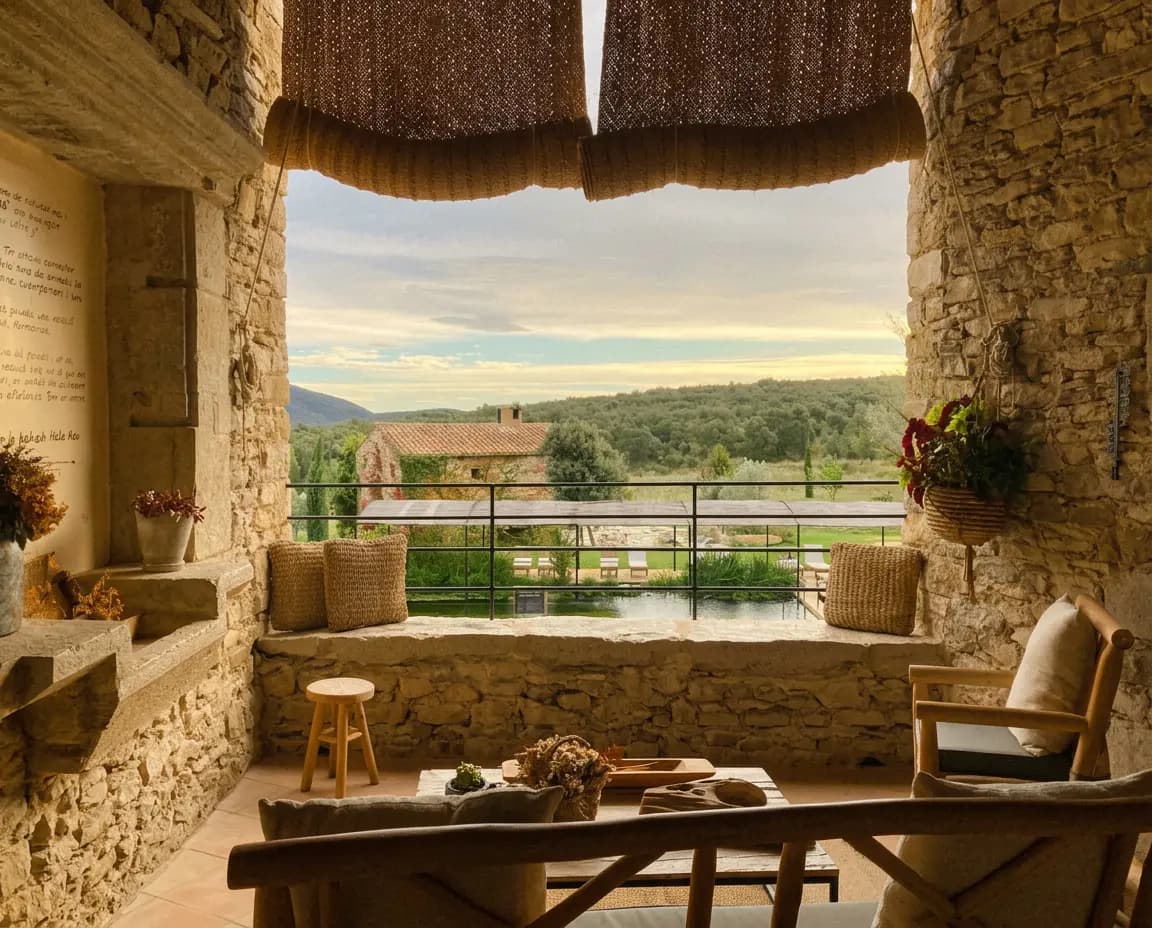
The road ends in forest. Can Buch sits above the Vall de Llémena, seventeen kilometres from Girona and six from the nearest village, with no mains electricity, no water pipe and no connection to a sewer.
The masía dates from 1621 and had fallen in on itself by the time Gerard Bofill found it: a scatter of stone in a spectacular position. Over three years more than three hundred people carried it back up the hill. Volunteers, neighbours from the valley, local artisans, travellers who had planned a fortnight in Catalonia.
It opened in the summer of 2020. Eight people live and work here full time now. Arrive at midday and nobody meets you at a desk. Lunch is being made, and you can hear it.
I discovered a lifestyle that cured me, that did me good.
Gerard Bofill Vaquè grew up in football. He came up through club structures in Barcelona, worked as a coordinator and director in youth football, and took a degree at INEF alongside it, on the reasonable assumption that the discipline would pay out in the usual way.
It stopped at twenty-two. "I was diagnosed with a tumour in my tibia," he told an interviewer years later. Osteosarcoma, in the right leg. It came back three times, and three more times he went into surgery.
What the illness left him with was a blank page. To earn a living he went back to the only field he had trained in and taught sport instead of playing it, and found he no longer much liked either the game or the city he was from. He moved to Girona. Then he and his girlfriend moved into a small farmhouse deep in the countryside and stayed four years: a vegetable garden, a few chickens, long stretches of quiet.
He read through those years. Nutrition, health, agriculture, geobiology, feng shui, holistic living, several hundred books of it, and stopped filing them as separate subjects. Soil, food, surroundings, health. One system, or none of it works. Every trip back to the city made the countryside look less like a refuge and more like the only option.
Then, out walking, he found the plot. A collapsed farmhouse from 1621, half swallowed by vegetation, no roof, no floor, no obvious reason to want it. Of everything he had looked at, it was the worst building in the best place. He wanted it.
Stay here
Ready to stay at Can Buch?
from €170/night


The money came from three places: personal and family savings, a bank, and rural development funds. The labour came from everywhere. Local artisans worked alongside volunteers, neighbours, friends of friends and people who had simply heard about it and turned up. More than three hundred of them across three years. They carried stone, mixed lime, raised walls, and learned on the job from whoever had learned it the week before.
Almost everything that went into the building came off the land around it. Stone found on site, clay, timber, ceramic, lime. Km0 in the literal sense, and no chemical products anywhere in the fabric. The techniques were the old manual ones, with geobiology and feng shui setting orientation and layout, and food sovereignty deciding where the gardens went. The house reads as part of the slope rather than something set down on it.
It opened on 8 July 2020, four months into a pandemic, into a market nobody could read. The summer filled anyway, on word of mouth, and it has kept filling since.
There are twelve rooms and a separate apartment: stone walls, timber, Catalan vaulted ceilings, several with terraces facing the mountains. They are named for what lives around the house. The chestnut, the holm oak, the hazel, the white poplar, the broom, the kingfisher.
A biopool built to work like a river running into a lake, kept clean by plants and microorganisms rather than salt or chlorine. A hammam made from stone and handmade ceramic taken out of the masía itself, so that what came out of the building never left the hill. A restaurant that is plant-based and km0, open to people who are not staying, cooking mostly what the garden and the farm produced that week.
Eight people live at Can Buch full time. Nina came to volunteer and stayed because the rhythm suited her. David keeps the farm and the animals. Ilyas puts guests at ease inside a minute. Khitam looks after the rooms. Ferran knows the land like a map. Marc has the gardens. Laura is the precise one. Oriol fixes things before anyone has noticed they are broken.
Gerard's mother, Lali, sits at the middle of it. She notices what people need slightly before they ask, and the effect on the house is structural rather than decorative. Sit at the long table while they cook and pass plates and talk over each other, and the arrangement is clear enough. This is a family that built a hotel, not a team that runs one.
"The most beautiful thing about our path is to share it," Gerard writes on the house's own website. It is the sort of line that usually means nothing. Here it describes the staffing model.
There was no electricity at the plot, no water supply and no sewer, and connecting to any of them was never seriously on the table. Can Buch runs on photovoltaic panels feeding battery banks. Rainwater comes off the roofs, filters down through sand and gravel, then gets pumped uphill by solar and runs back to the house under its own weight, which is why the pressure is good. Heat and hot water come from biomass: wood cut from their own forest under a management plan that thins it, strengthens it and lowers the fire risk in a comarca that needs the help. Wastewater goes out through gravel and plants and comes back as irrigation for the fruit trees.
Food runs the same loop. Gardens, orchards, animals, compost, seed, kitchen, back to compost. What grows here feeds the people working and staying here, and what is left goes into the soil. Around the edges of it: beehives, insect hotels, bird boxes, corridors planted to flower in sequence. Rabbits in the grass, chickens across the path, sheep in the field. Permaculture done as maintenance rather than as a position.
Occupancy solved itself. Word of mouth and a steady trickle of social media did the work a marketing budget would normally be asked to do, and the house has spent years booked months ahead. The logical next move was more of it, somewhere else, at scale. Gerard drew up an expansion plan and withdrew it almost as soon as it was on the table.
I conceived this with my heart more than my head.
Gerard BofillThe profits go back into the buildings and into the quality of what they grow. He has said, on the record and without softening it, that anyone who passes through Can Buch goes home better than they arrived, which is a large claim for a farmhouse to carry.
Drive up the valley on the right morning and you can buy a dozen eggs from him. Bread, beer, fruit, whatever the garden has too much of, sold at the door for less than the shop, because there is nobody standing in between.