
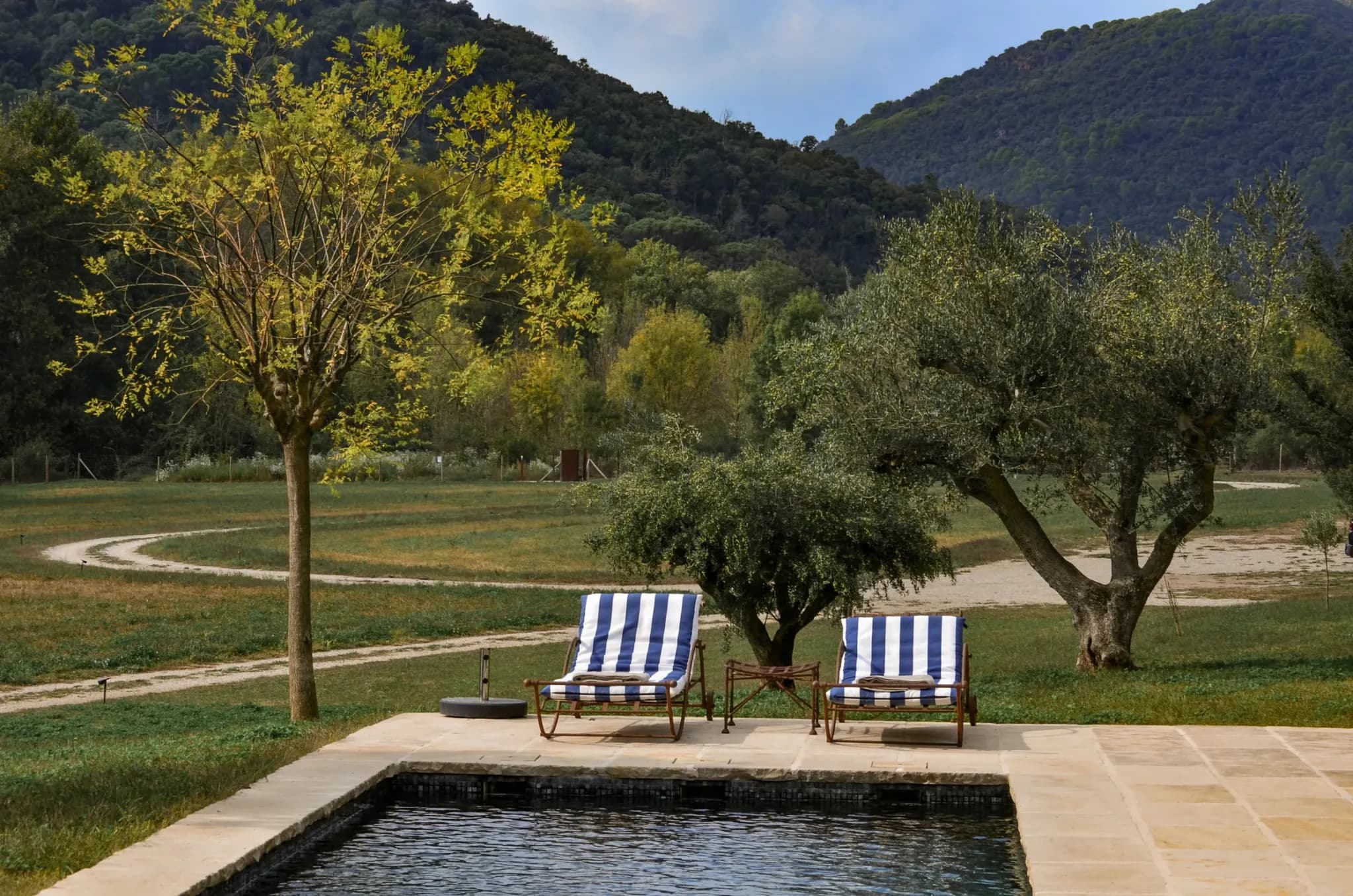
A few weeks ago, Solwyn took a ride into the hills of Girona, driven only by the name Mas Margot. A hidden gem freshly opened in May, it sits quietly among forests and stone, the kind of place you find only by intention.
It's hard to imagine that just a few years ago, this farmhouse was little more than a memory — its roof gone, its rooms exposed to wind and rain, slowly reclaimed by nature. Today, it stands reborn, shaped by two people, Julio and Michèle, who chose to rebuild a house as well as their whole way of living.
Nothing about Mas Margot feels staged. From the first step through its doors, there's a calm that is natural, a warmth that doesn't perform but simply exists. A quiet welcome into another rhythm of living.
The house had its own way of speaking. We just learned to listen.
Who are they?
Michèle and Julio come from different corners of Europe — she from Luxembourg, he from Spain — but their paths crossed in Barcelona, a city that became both their home and the start of a shared story. Michèle led the legal arm for a large international group while Julio built his career in banking. Life was full, busy, and often moving faster than they wanted it to.
Then came the stillness of the pandemic — a pause that gave shape to a question they had long felt but never voiced: could life be lived another way? They began to imagine a rhythm closer to the land, one that combined living and hosting, work and meaning. The idea wasn't born from rejection of their past, but from curiosity about what else was possible.
Their first thought was simple: a small guesthouse, something manageable where they could welcome travelers and share daily life. But vision has a way of growing once it finds conviction. When they started looking for properties, they had no map, no list — just an intuition that they would recognize the right place when they saw it.
That moment came in the quiet hills of Girona, when they stepped into an abandoned farm nearly fully overtaken by nature. The previous owners had inherited it with the hope of restoring it but couldn't afford to continue. "Restoring the farm needed a massive investment," recalls Julio. "There were trees growing inside the house." Most would have walked away. Julio and Michèle stood still. Beneath the ruin, they saw a life waiting to be rebuilt.
Stay here
Ready to stay at Mas Margot?
€280/night
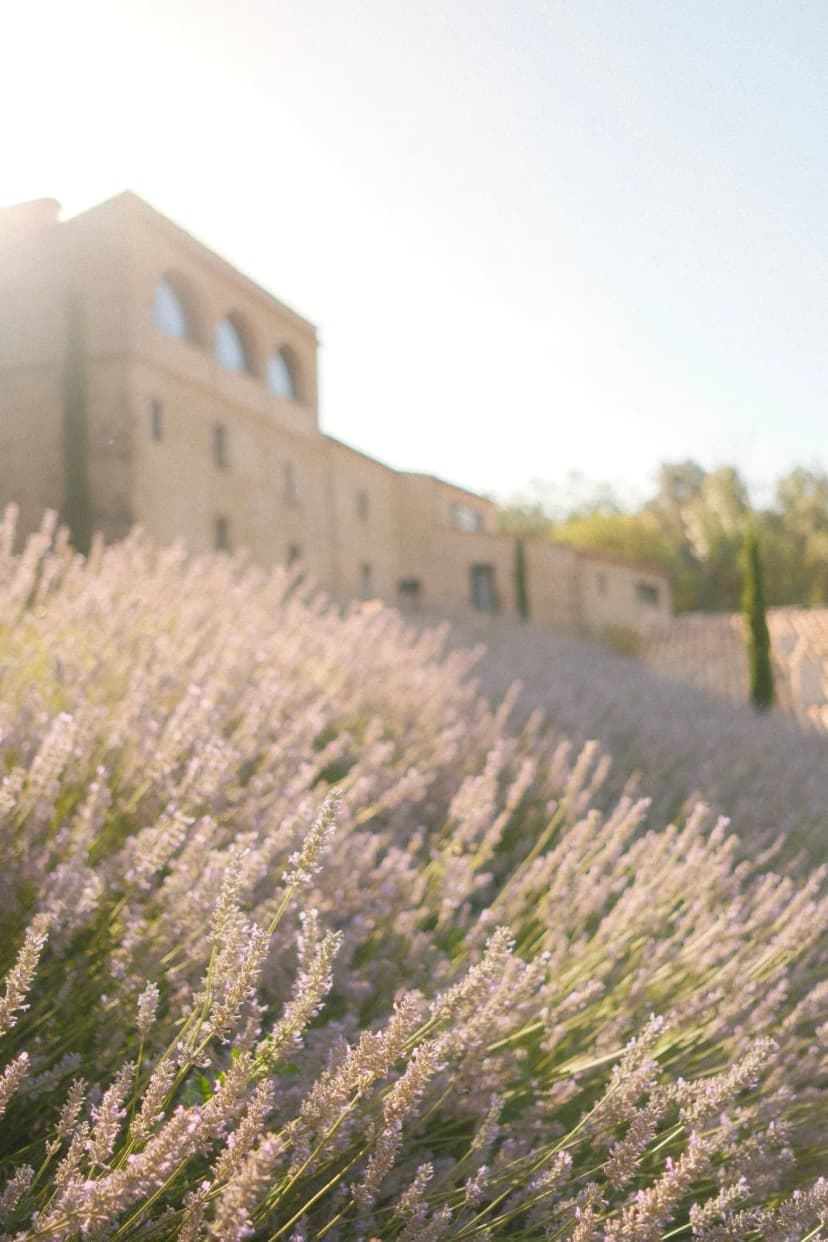
When Julio and Michèle first began planning their guesthouse, they imagined something modest — a small retreat, simple and personal. But as they peeled back the layers of the old farm, its potential began to unfold. What was meant to be a smaller project slowly grew into something larger, more ambitious, eventually revealing the structure's true potential. They often laugh now, saying they "went a bit crazy."
What started as a few rooms became a full-scale restoration. Today, Mas Margot is home to eight beautifully designed rooms, each one quiet and full of light, with luxurious soaking bathtubs and wide windows that frame the hills of Girona. The landscape feels close here — you wake to birdsong, to mist rolling through the valley, to that stillness that makes you breathe differently.
But getting there was far from effortless. Every day brought a new surprise: a roof that had collapsed overnight, a hidden fault buried in the old stone, the endless patience required by heritage restrictions dictating window shapes, colors, even the smallest details. Still, Julio and Michèle never saw these as obstacles. They became part of the rhythm, a conversation between past and present.
Working with Llimona Casa, an interior design studio from La Bisbal d'Empordà, they rebuilt Mas Margot with sensitivity. Their goal was to preserve what mattered most: the soul of the place. The result is a quiet balance — old stone and clean lines, warm wood and natural light, texture and simplicity. Nothing feels excessive. Everything feels deliberate. The house stands now as if it has always been this way: anchored to the land, open to the sky, honest in every detail.
The soul of Mas Margot lies in its balance between preservation and renewal, between memory and intention. From the beginning, Julio and Michèle were clear: they didn't want to erase the farmhouse's past. They wanted to listen to it. Their architect, a local specialist in masías, helped them find that balance. Honoring the heritage of the mas was never a rule to follow, but a choice to respect. They kept the window proportions, the original roofline, the ochre shutters. In doing so, they found a quiet harmony — where modern calm meets rural honesty.
Inside, the result feels effortless. Old stone meets smooth plaster; raw wood rests against brushed metal. There's warmth in the textures and restraint in the lines — a dialogue between rustic charm and minimalist precision. As Julio says, they wanted to "mix the old and the modern, but never lose the soul of the house." Some of the most beautiful details came from the structure itself. They kept the original arched wine cellar — the volta catalana — carved beneath the house, a space that once stored barrels and now stands as a quiet reminder of the mas's agricultural roots.
The interiors carry the same thoughtful restraint. Every room holds small gestures that reflect Julio and Michèle's sensibility: niche alcoves with hand-painted finishes, reclaimed furniture, ceramics collected from nearby artisans. Subtle references to the region's artistic heritage echo through the house — hints of Dalí's surreal balance between dream and landscape, abstraction and earth. There is even an actual artifact from the artist in the house: Michèle's father kept a copy of Dalí's libretto to his Être Dieu opera-poem, with the dream of turning it into a theatre play.
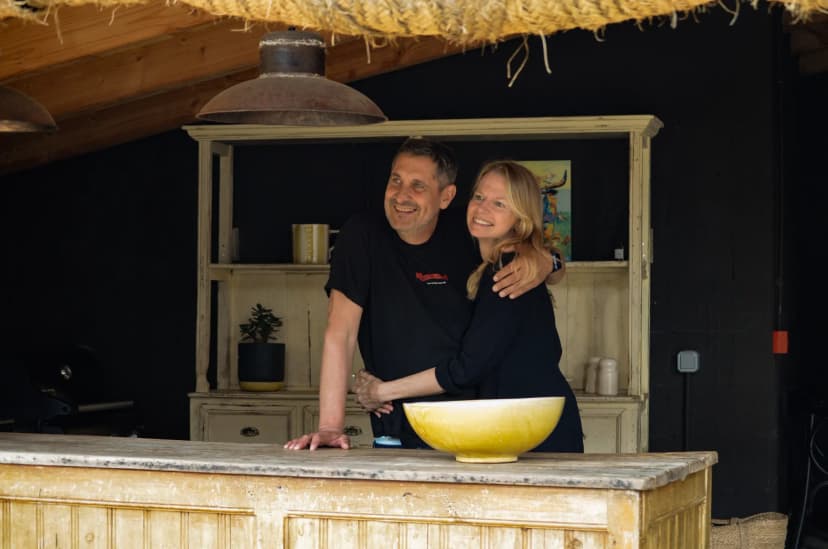
Julio manages the practical rhythm of the house — shopping daily for fresh produce, preparing meals, fixing whatever needs fixing. "Everything is fresh," he says, a quiet pride in his voice. "Vegetables from nearby farms, olive oil from a neighbor's grove, charcuterie and cheese from Girona's finest." Michèle focuses on guests, from sending out their welcome messages to hosting breakfasts that stretch into meaningful conversations. Together, they create a kind of hospitality that feels unforced.
Most of the guests are couples seeking to disconnect — to exchange noise for silence, screens for sky. Some come for the cycling routes that thread through Girona's hills; others, for the stillness and slow rhythm of the countryside. Regardless of reason, everyone who arrives feels the same thing: that rare comfort of being cared for by people who are fully present.
Some people come for a week to do activities and visit around, but they end up not moving from the mas. I joke with Julio and ask if we did something wrong.
Michèle PenningOf course, it's the opposite. That quiet stillness — that desire to stay — is the ultimate proof that Julio and Michèle are doing everything right.
Mas Margot was rebuilt with deep respect for its surroundings. From the beginning, Julio and Michèle wanted the house to live in harmony with the landscape, not just visually, but ethically. The restoration relied on natural materials, including eco-friendly insulation made from pure wool that regulates temperature and breathes with the walls. On the roof, 50 solar panels quietly generate clean energy, while an aerothermal heating system keeps the house warm through Girona's colder months.
Sustainability for them doesn't stop at technology. The couple sources all their products from within reach. By guiding guests to small restaurants and local artisans, they help the community thrive around them.
At dusk, Julio and Michèle often sit outside, the last light fading over the valley. The house stands behind them. Once broken, now whole. "It changed us," Julio says simply. "It taught us how to wait."
In a world that celebrates speed, Mas Margot stands as quiet resistance. Here, beauty grows in the pauses. In the work done by hand, in the unhurried mornings, in the space between one breath and the next. Julio and Michèle remind us that slowing down isn't about doing less, but about feeling more.
Building Mas Margot took everything they had: time, courage, patience. What they received in return was a whole new life.
It's in the faces of guests who stay longer than planned, and in evenings when the valley just sits in silence. In the quiet pride of two people who turned ruin into home.