
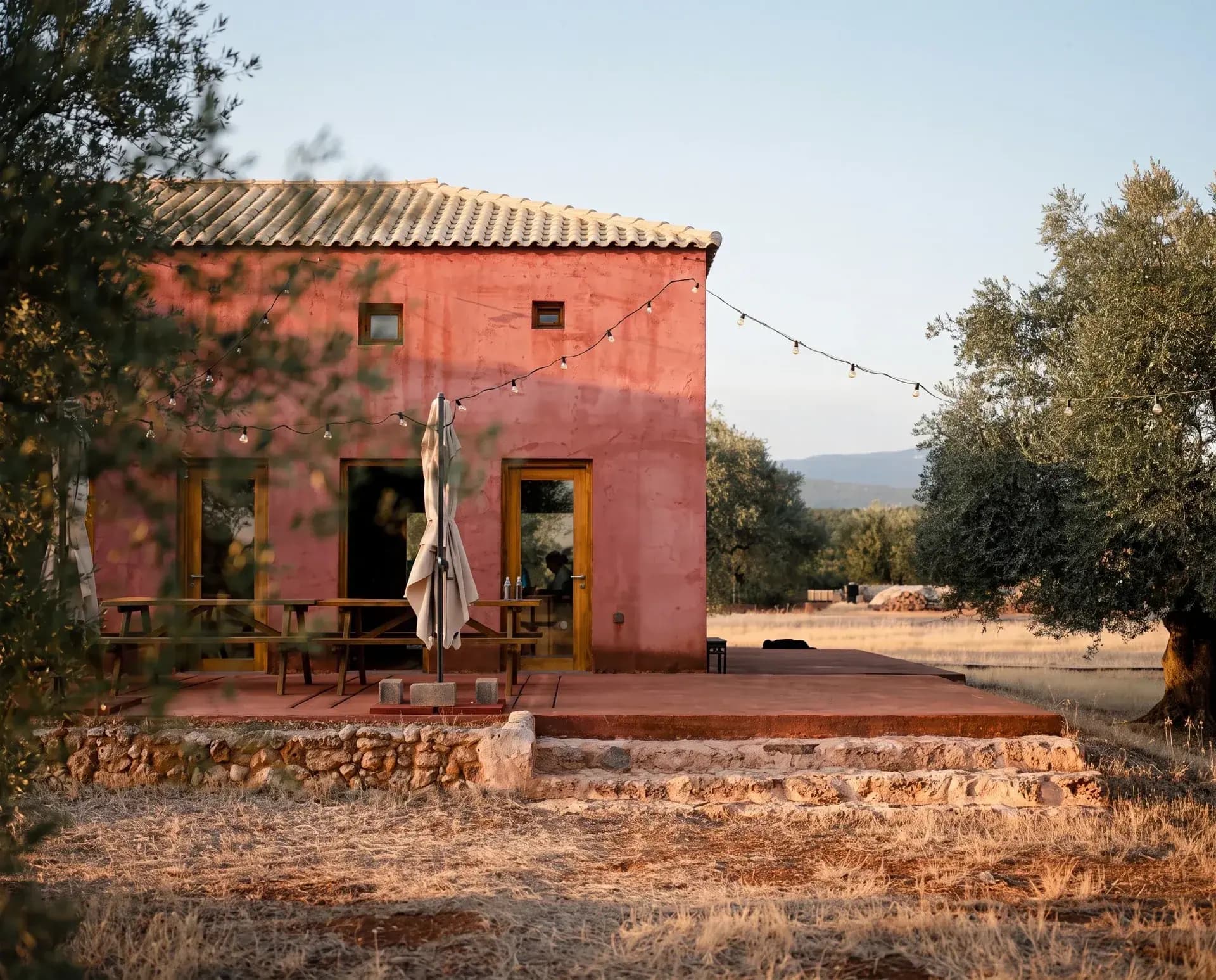
Eumelia is an organic farm and guesthouse in Laconia where an olive grove worked by the same family since the 1890s was brought back biodynamically and opened to guests who come to eat, harvest, and slow down.
He came back for the paperwork. The idea was to sign what needed signing and return to the city.
Frangiskos grew up outside New York and read International Relations at Johns Hopkins. For most of his adult life he worked in policy and institutions, lost in meetings and flights. The farm in Gouves was the family's: his great-grandfather had worked its olive trees, and the land had passed down since the 1890s. By the time it reached Frangiskos it had gone quiet. Groves untended, buildings slipping toward ruin. He went back in the early 2000s to settle the title to the land, expecting to be there a season at most. Drawn by the land and a growing desire to build something tangible and rooted, he chose to leave behind his career and create a new life on his family's ancestral soil.
His wife, Marilena, is the other half of the place. She met Frangiskos through a sustainable tourism project she was managing, when she visited the farm as part of a study tour. After seeing the project firsthand, she left Athens, joined him in building Eumelia, and helped turn it into the immersive farm-stay experience it is today. She cooks the meals that come off the farm, and she pairs them, glass by glass, as a trained sommelier. Frangiskos took a diploma in permaculture and read his way into biodynamics; he also has a background in homeopathy, which turns out to matter more than it sounds. Between the two of them they run the farm, the kitchen and the houses, with help through the year.
What he found in Gouves was less a farm than the memory of one. The grove was overgrown, the older trees half-wild, the younger ones already decades neglected. At the centre stood a tree said to be more than two thousand years old, still throwing out leaves. He could have signed and left. People do. Instead he started clearing ground, and the season he had set aside became the rest of his life.
He was not a farmer and did not pretend to be. He took the permaculture diploma and spent years learning what the land would and would not do: which slopes held water, which trees were worth saving, how to farm without stripping the soil. The plan was never to make the grove tidy. It was to make it work again, on terms the land could keep.
The farm came back before the guests did. Within a few years it was producing again, and in 2009 the first houses opened to people who wanted to stay on a working farm rather than near one. Eumelia - a word they translate as harmony - had its first visitors.
Stay here
Ready to stay at Eumelia?
from €236/night
We want everyone to get a sense of our lifestyle. The best way to do this is to introduce them into the farm.
MarilenaFrangiskos farms biodynamically, which in practice means treating the whole place as one system rather than a set of separate crops. The olive oil is pressed from three varieties grown together - Myrtolia, Koroneiki and Agrelia - alongside the wild olives that were already there. Almonds are planted among the olives; pine, cypress and vines were brought in to hold the soil and shade one another. The point is to spread the load so no single plant carries it alone.
The vineyards run to five local grapes (Kydonitsa, Athiri, Moschofilero, Agiorgitiko and Avgoustiatis) on red clay, handpicked and stomped by foot the old way, then left to ferment without much intervention. Raised beds feed the kitchen through the year. A spiral of Greek herbs climbs a low mound: oregano, thyme, rosemary, saffron, the St John's wort that goes into the soap. And there are pigs, the near-extinct black pig of Greece among them, raised with a Greek group that catalogues rare breeds and places them on farms to keep them going.
He talks about the farm the way a doctor talks about a body: parts in conversation, stress kept off any one of them, a thing kept well rather than merely run. The homeopathy, it turns out, was never far away.
Everything at Eumelia points back to the table. You eat what the farm grew that week, and most of what's poured was made on the same land. The stay is built around that, not around a list of facilities.
There are four houses today, each named for what grows nearby: the Grape Vine House, the Lavender House, the Almond Tree House and the Sunflower House. Each has its own garden, a fireplace, a long veranda facing the mountains. The building is bioclimatic rather than decorative: ochre walls in natural plaster tinted with mineral pigment, raw timber beams, geothermal heat through the floors in winter, natural mattresses and linen. The shared building, the Womb Lounge, is clay-toned and built around an open fire, with a small library, board games, and a terrace where dinner is served under the stars.
Dinner is Marilena's. She cooks what Forbes described as "the most perfect, this-is-why-you-travel-to-Greece meals". They are made from whatever the season gives - dandelion greens, a fava purée, sausages run through with orange peel, bread, the farm's own oil, and she pairs each course with the natural wines, glass by glass, as a level-three sommelier. Meals are long and shared, often outside, often with music; on harvest nights guests are pulled into the grape stomp themselves, barefoot in the vat. It is not a restaurant pretending to be a farm. It is a farm that happens to feed you very well.
Beyond dinner, the farm is open to be worked. Guests press olives in autumn, stomp grapes at the vintage, take cooking classes and wine tastings and walk the groves with Frangiskos. The set piece is the olive harvest each autumn, an immersion of picking, pressing, cooking and soap-making, run in waves across the season. None of it is compulsory. Day visitors are welcome too; you don't have to sleep here to eat here.
Eumelia sometimes calls itself the greenest farm and hotel in Greece. It is the one line about the place that reads like a brochure, and it rather undersells the rest, which is quieter and more thorough. The systems are the part worth knowing.
Heating and cooling come from a geothermal pump and the sun; the fires are high-efficiency wood. Used water, the washing-up, the baths, all of it, is run back through the ground by a root-bed method and ends up irrigating the groves. Cooked scraps go to the dogs and pigs, raw ones to the chickens. The linen is line-dried and changed every third day, not every morning. The farm carries Slow Food Farm accreditation. Almost none of this is mentioned to you while you're there.
At the centre of all of it, the old tree is still standing, two thousand years of it by the family's reckoning, older than the road to Sparta. Frangiskos came to sign for it and stayed to tend it, feeling "the intense need to create something here, to the land of his ancestors." The olives are still being pressed. Most years there's music.
A working farm, not a film set of one. Hospitable without performing it. The kind of place where the best thing on the table was alive last week and grew up the road.