
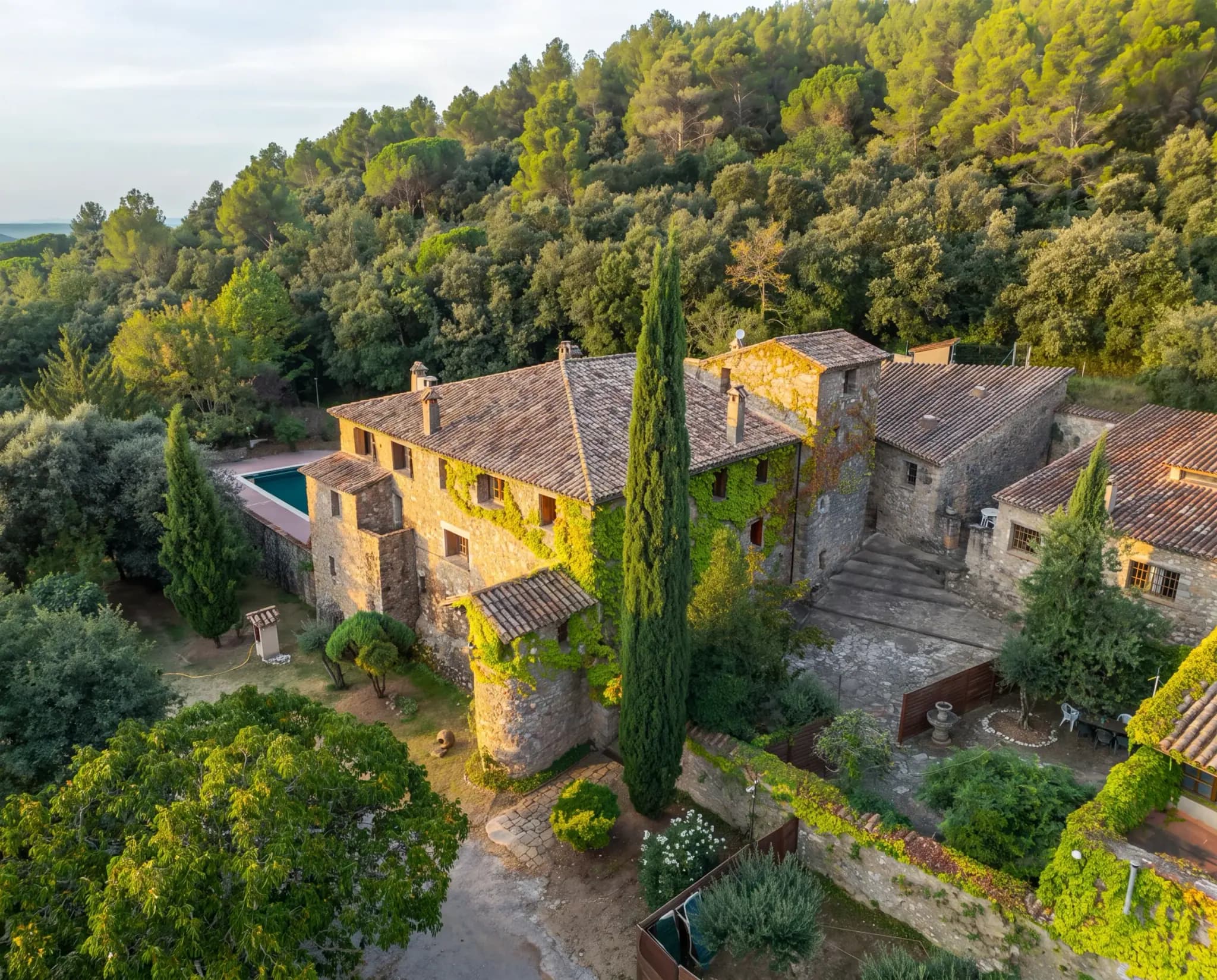
The first impression isn't of a hotel. It's of a tiny stone village. The main house, the barn, the courtyard, the pool, the gardens. All encapsulated within the same set of weathered walls, all built from the local rock, all standing in some form for four hundred years.
Off Grid sits almost at the end of a country lane that runs north out of Maià de Montcal and gradually narrows until you're certain you've taken a wrong turn. You haven't.
The lane delivers you, eventually, to Mas Salvanera, a 17th-century masía in the hills of the Garrotxa, restored over the past year into a rural hotel with ten rooms. Gerard meets us in the courtyard. Him and the team of Off Grid, we'll come to learn, are the kind of people who show you a building the way you'd want a friend to show you their childhood home. Slowly, and with stories.
The founder of Off Grid is Gerard Greene, an Englishman with a backstory that's almost the opposite of this place: he co-founded YOTEL, the compact, capsule-style city hotels with pod rooms in Times Square, Heathrow, Schiphol, Singapore. Decades of fast hospitality. The opposite of slow.
He parted with his investors a few years ago and went looking for what he calls "something beautiful and meaningful, in the sun, with mountains, the sea and plenty of nature." He found Mas Salvanera by accident in 2024 and bought it. He spent the next year restoring it, then opened in September 2025.
The day-to-day is run by a small team. The manager who walks us through the rooms also spent years at the other end of the industry. Five-star, traditional, branded. The flashier the better. She speaks about it without bitterness. "It teaches you a lot about standards. About maintaining things very well, because the investment behind is very high." She did it with all her heart, she says.
Stay here
Ready to stay at Off Grid?
"Arriving here, I realised how much I had to learn. And how much luxury there is in switching off and stopping the time."
GerardThat sentence is the spine of the place.
The work was done in collaboration with Ariadna Puigdomenech, a Girona-based designer, and the brief was almost the opposite of what you'd expect from someone with Gerard's background. No gimmickry or design language imposed onto a building that had its own.
What's striking about the restoration - and we say this having walked through dozens of masías in this region - is how much the team chose not to do. Most renovations of buildings like this end up sanding the past out. The walls go too smooth, the light too even, and the proportions slightly off. Off Grid however feels like a building that was waiting to be uncovered rather than rebuilt, and it gives the whole place an almost archaeological quality. You feel, walking through it, that you've stepped into a working time machine. Except everything is more comfortable than it was the first time around.
"More than a refurbishment, what we did was an unfinishing."Gerard
The walls were stripped back layer by layer to their oldest paint, and finished in lime wash. Lime wash is the most punishing paint to apply, she explains, but the only one that lets a building like this breathe.
The interiors elsewhere follow the same logic of restraint. Hand-cut tiles from La Bisbal d'Empordà, the ceramic capital of the region. Reclaimed terracotta. Local stone sinks. Monsoon showers. Where the original furniture could be saved - writing desks, armchairs, paintings, a small dresser that had been neglected for years - it was stripped, treated, reupholstered, and put back.
The main house is built across three levels, and walking through them in order is its own short education in how Catalan farms used to work.
The ground floor, where the kitchen and dining room are now, was the animal shed. The proportions still tell you that: the lower ceilings, the heavy stone, the way the light comes in. It's where the family's livestock would have lived, sharing heat with the house above. Today it's where guests gather around the long table for breakfast, and family-style dinners when the kitchen is open.
The first floor, which is now a living room and lounge with views over the pool, used to be the kitchen. The team has left some of the original elements in place rather than tidying them away: the iron hooks in the ceiling where preserved meats and dried herbs would have hung, and a cauldron still suspended from one of them.
The second floor is the most beautiful room in the house. Another lounge, anchored around an old open fireplace, with a small library tucked into a gallery built into the room. You can sit by the fireplace on the lower level and look up at someone reading on the gallery above, and the geometry of the space feels both medieval and entirely current. It's the kind of room where guests end up at the end of an evening without quite deciding to.
Some things had to be bought new. The mattresses, for instance. And it's in the things that had to be new where the philosophy of the house sharpens into something specific.
The mattresses come from Sivana, a small workshop in Murcia. They're made entirely from natural fabrics - wool, linen, cotton, including the threading - and they're heavy. Sivana cannot supply large hotels. The owner came to visit recently and mentioned something that stayed with the team: many of his employees are people who can't work in conventional environments because they were born with allergies that prevent contact with chemicals or pollution. Sivana is a place where they can.
The bed linen comes from BeKume, founded by Nuria Gómez in Mataró, an hour down the coast. It's 100% organic cotton, but cut and woven for the look and feel of a t-shirt rather than the crisp, super-starched sheets that hotels default to.
The bathroom products are from Olively, a company from Andorra started after the pandemic by Ivon, a former professional golfer who, during lockdown, returned to her family's olive grove and began experimenting with olive oil and essential oils. The scents come from Shizen'na, a small perfumer in Girona working only with essential oils. Off Grid is in the process of developing its own scent with them.
Each of these suppliers is local, and the team of Off Grid puts great effort into finding them. They call it serendipity, but always with a qualifier. Serendipity as something earned through looking very, very intensely.
The thing we didn't expect, and the thing that stays with us most clearly afterwards, is the silence.
Off Grid is full when we visit, or close to it. There are guests in the pool, guests at the long table, guests on bikes coming up the lane. None of this seems to make any noise. You can sit at the edge of the pool with the house at your back and hear, in order: the wind, an insect, water moving somewhere, your own breath. That's it. The estate has a kind of acoustic geometry to it. The stone walls, the position of the buildings, and the way the courtyard is shaped absorbs sound without making the place feel empty. We've stayed in plenty of rural hotels that go quiet at night. We can't think of one that stays this quiet at lunchtime.
It's something the manager doesn't talk about explicitly, but it's the thing that lets everything else work. The slow meals. The longer conversations. The way you find yourself, on the second day, having a small unexpected thought and being able to actually finish it.
Days here have an open shape. Breakfast happens slowly, near the pool when the weather allows. The kitchen runs an all-day menu built on what the chef calls KM0 — produce sourced within a kilometre or two of the kitchen wherever possible, supplemented by the property's own permaculture garden, which is in its second season and starting to deliver. Dinner, when guests want it, is served family-style at one long table.
Three lounges sit open through the day, each with an honesty bar. Natural wines, local beers, the IPA from Hopsters Brewery in nearby Besalú, complimentary water and coffee. There are no televisions in the rooms. There will be no telephones either. The Wi-Fi works.
What guests do between meals depends on what they came for. Many come for the cycling. Girona is, by some measure, the cycling capital of Europe; Gerard is a serious cyclist himself and has mapped more than thirty routes that start at the door, ranging from twenty to a hundred and fifty kilometres. The bike workshop is properly equipped. Others come for yoga retreats - the garden studio is built for it - or for the trails that leave from the property and disappear into the foothills of the Pyrenees. Costa Brava is thirty-five minutes by car. Cadaqués is an hour. Perpignan, across the French border, is just over.
A surprising number of guests don't move much.
The newest project is the farm. The manager is, as she puts it, learning constantly, and excited in a way that makes other people laugh, because the things she's excited about are so grounded. Three speeds of compost. Why orange peels need to stay separate. Why eggshells go in a pile of their own. Dairy and meat in the fastest-decomposing pile.
"It's overwhelming at the beginning. But then you get into it, realise what's happening and what's going to happen, and you just want to do more."
The garden is patient work. They are starting to grow some of their own vegetables, and there will be fruit eventually, but neither can be rushed. The wider sustainability picture follows the same logic. Natural spring water on tap. On-site composting. Solar-ready, with full renewable energy and expanded rainwater harvesting in the plans.
The aim, she says — and she says it without ornament — is to leave the place better than they found it. "It's not for us. It's for those to come."
Off Grid is for people who have figured out what their time is worth, and are looking for somewhere that takes that as seriously as they do.